
Infinite Simplicity | Chapter 5: Approach

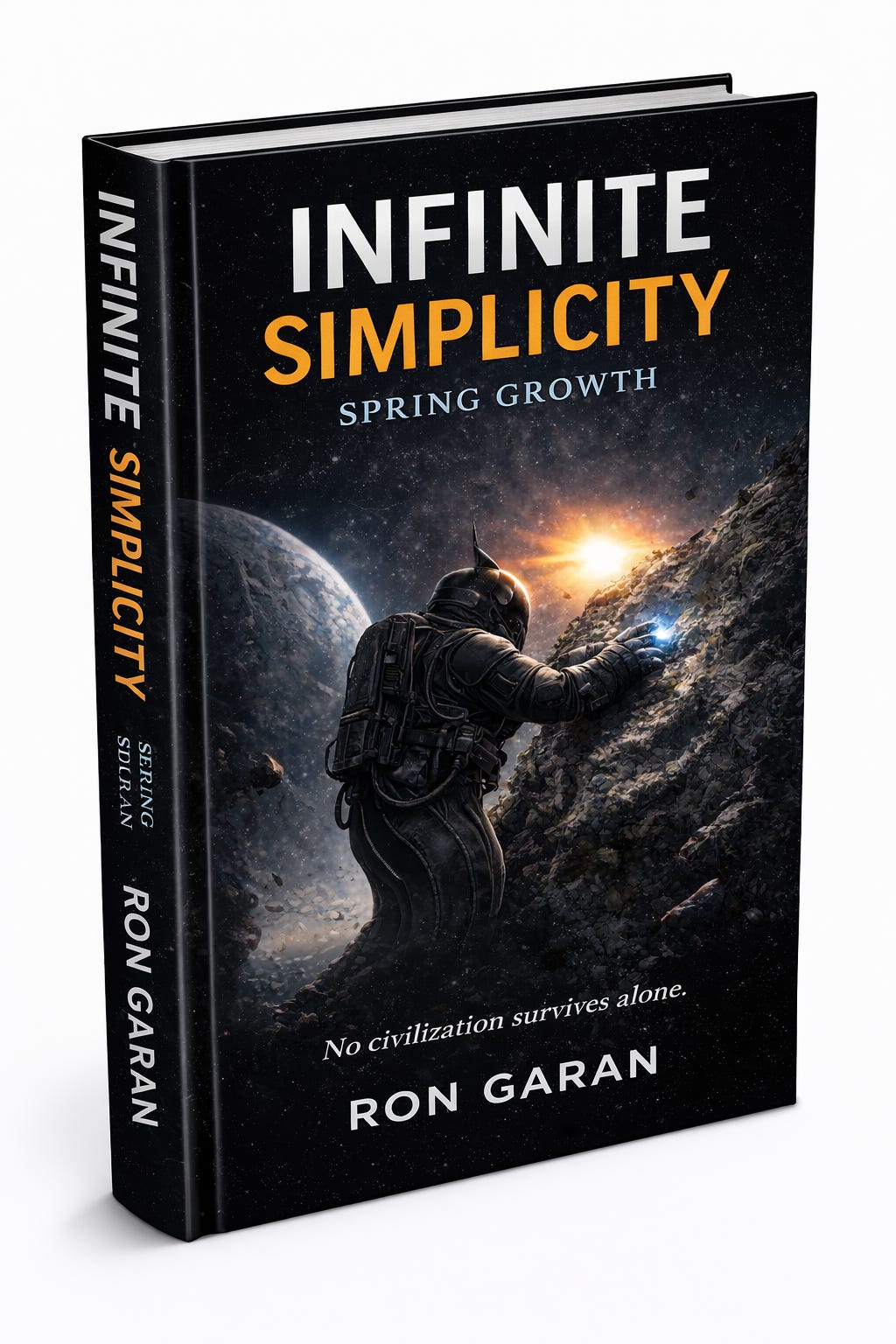
Before we get to Chapter 5, I want to thank everyone who has joined us on this journey.
Since the last chapter, the number of subscribers following Infinite Simplicity has grown from roughly 140 to over 250. Many of you arrived through my recent conversation with Marianne Williamson, which you can watch here: [link]. I’d like to extend a special welcome to the new crewmembers who have come aboard.
One of the things I’m discovering as I share this novel chapter by chapter is that reading a story together feels different than reading it alone. The reactions, comments, and messages help me understand what is landing, what isn’t, and which questions readers are carrying forward.
Chapter 5 contains a decision I’ve been looking forward to sharing for a long time. Aadi reaches a point where he can no longer carry his experience alone and must decide whether to trust someone else with it.
After you’ve read the chapter, I’d be especially interested in your thoughts:
• How did Aadi's decision to tell Nien land for you?
• What part of this chapter stayed with you after you finished reading?
• What questions are you most interested in seeing answered as the story unfolds?
Thank you for being part of the journey. Please subscribe and join the crew on the mission.
New here? Start with Chapter 1 → [link]
Now, on to Chapter 5.
Chapter 5: Approach
It is 0210 ship time.
Up here, time is arbitrary.
It isn’t shaped by the angle of our planet’s rotation or the slow reassurance of a rising star. It exists mostly to keep us synchronized with the ground, where such things still matter.
I’ve been awake in my crew quarters for over an hour. There are four hours until scheduled wake-up, a time-remaining that I have been recalculating at an unhealthy frequency. Sleep feels unreachable. Nervous energy coils in my chest, leaving no room for rest.
I try not to think about failure.
That’s a lie.
Failure is all I think about.
If we fail to place Threshold inside the narrow envelope of survival, the outcome is already written. There will be an initial flash bright enough to erase cities. After that, darkness, silence, the long unraveling of everything that remains.
I float closer to the mirror bolted onto the wall of my coffin-sized quarters. An unfamiliar strained face looks back at me. Exhaustion makes me question my own reflection. Sweat beads across my skin, each droplet perfectly round hemispheres clinging where gravity should be.
I shake my head.
The droplets scatter, reforming instantly into floating spheres. Little balls of sweat, each with its own escape velocity.
The sight almost distracts me.
Almost.
What weighs on me nearly as much as the planet’s fate is what will happen to Nien and me.
The laws of physics dictate that we will escort Threshold all the way in. If the deflection fails, we will have front-row seats to extinction. Communications with the surface would likely persist for a while; fragmented, desperate, unbearable. We would hear the reports until we didn’t.
And when our own supplies finally dwindled, we would face a last decision: die quietly aboard Jiandan or ride the reentry module down to join the rest.
Why did I volunteer for this?
The question lands with weight and sorrow.
My chest tightens further. My hands are clenched. Sweat beads reform. I fight the sudden urge to vomit.
It would have been easier to stay on the ground. To share the risk instead of carrying it. To be one of the many instead of one of the accountable.
Sleep is impossible like this.
Eventually, I give in.
I take one of the strong pills. The kind meant for emergencies, not routines. I climb back into my sleeping bag, kill the light, and wait for chemistry to dissolve regret.
∞
The ship settles into its long approach phase, the kind that invites false calm. No alarms or countdowns, just the steady hum of systems doing exactly what they were designed to do.
The pill I took last night did its work. The Flight Engineer is on duty again.
Threshold has resolved from abstraction into certainty. No longer a cluster of pixels, no longer a probability cloud. It has shape now. A faint, uneven albedo that suggests a history of collisions and fractures. It turns slowly, indifferently, as if the universe spun it once and then forgot about it.
“Spin rate’s higher than predicted,” Nien says, eyes locked on the forward display.
“How much higher?” I ask.
“Enough to matter.”
Not a comforting answer.
I pull the latest telemetry into my workspace and begin updating the models. The numbers shift slightly. Each revision tightens margins that were already uncomfortably thin.
“At that rate,” I say, “we’ll have to burn prop just to stabilize it before mounting the charge.”
Nien nods. “Less margin after detonation. The window shrinks.” He looks back at the display. “Which means we don’t get a second try.”
The ship feels smaller the closer we get. Jiandan hasn’t changed, but nothing inside it is neutral anymore. Every surface carries context. Every system hum is either stable or the beginning of a problem.
I run diagnostics on the charge-mounting assembly for the third time. Everything checks out. Of course it does. Hardware is rarely the problem. It’s almost always those boxes we never thought to check.
“You ever notice,” Nien says casually, “that the most dangerous phase of any operation is the one everyone agrees is straightforward?”
I glance at him. “That’s because straightforward is usually code for ‘we’re out of options.’ No options means we no longer have the need to contingency plan.”
He smiles thinly. “Or the luxury.”
A ‘ding’ announces a new data packet. I pull it across my display.
“It’s from PAM,” I say.
PAM is shorthand for Public Affairs Management.
To: Flight Engineer
From: Public Affairs Management
Subject: Crew Interior Walkthrough Recording Request
Aadi,
During scheduled mission timeline white space in the next two Flight Days, PAM requests a short interior walkthrough recording of Jiandan for public distribution.
Civilian network coordination teams assess public engagement value as high across participating regions at this stage of the mission. A crew-perspective walkthrough is expected to support public alignment around mission objectives.
Please ensure no commercial identifiers are visible and keep commentary apolitical.
Suggested talking points attached.
Thank you,
PAM
“It looks like they want a video tour of Jiandan,” I say. “With some words of encouragement.”
“Same here,” he says.
They call it a walkthrough, not a flythrough.
Nien glances over. “Nothing says planetary emergency like approved messaging.”
I scroll further down the packet.
“No commercial identifiers,” I read aloud. “Wouldn’t want the end of civilization accidentally sponsored by a beverage company.”
Nien snorts.
“Keep commentary apolitical,” he reads. “Apparently extinction still has communication guidelines.”
I scan the talking points. It’s the standard stuff: we’re all in this together, we carry everyone’s hopes and dreams, thank the larger team, thank the public, project confidence and competence.
The talking points don’t include where we’re from. As if acknowledging where we’re from might make it harder for folks to support the mission.
I thought the threat of extinction would be enough.
It should be.
I’m not sure reassurance is something we can honestly offer.
“That camera is not going anywhere near my crew quarters,” Nien says. “Yours already looks like it belongs in the brochure.”
“That’s because things stay where I put them,” I say.
Another data packet arrives on my channel.
I skim it quickly. Updated risk assessments. Revised procedural constraints. A reminder again about adherence to protocol in the event of anomalous readings.
They are tightening their grip.
I imagine Hu Brishamper somewhere far behind us, watching probability curves, confident that control is something that can be asserted from any distance.
“Nien,” I say, “they’re pushing hard on procedure.”
“My side too,” he replies. “Different language, same pressure.”
Two feeds. One reality.
We exchange a look. Nothing dramatic. Just acknowledgment.
Co-command, in practice.
Outside, Threshold continues its slow turn. The surface is darker than expected in places, lighter in others. A scar runs along the detonation band, a reminder that survival is often just accumulated luck punctuated by violence.
Something stirs at the edge of my awareness.
A sense of alignment. Like the awareness of a handrail in the dark.
I pause.
It doesn’t intrude. It simply waits.
The realization should be comforting.
It isn’t.
I don’t invite it closer.
I don’t push it away.
I let it be.
“Nien,” I say after a moment, “if the mass distribution is worse than expected?”
“We’ll adapt,” he says immediately.
“If the spin won’t dampen—”
“We’ll adapt.”
“If the numbers don’t converge?”
He finally turns fully toward me.
“Then we’ll do what we can,” he says. “That’s all there is.”
The words land heavier than they should.
He glances toward the viewport.
“They don’t get to wait for us to be sure.”
I nod and turn back to the models.
The approach clock continues its silent countdown. The window narrows with every kilometer we close. Somewhere inside the asteroid, physics waits patiently for us to make a mistake.
I look at Threshold again, really look at it. Not as an enemy target but as a test. A test that I regret signing up for.
I cross-check thermal tolerances on the mounting brackets when the presence returns.
You are carrying this alone.
My hands still.
I don’t respond.
I wait for the familiar follow-up, the reframing, the half-remembered insight. Instead, there is only stillness. Attention without pressure.
That feels worse.
“I didn’t ask for this,” I think, careful to avoid saying anything out loud.
You did not ask but you listened.
A flicker cuts across my vision.
I force myself back into the task at hand.
“Nien,” I say, louder than necessary. “Confirm we’re still green on attitude control.”
“Green,” he replies without looking up. “Why?”
“No reason.”
A lie.
It seems obvious that the presence, or whatever this is, is observing me. It feels like judgment, even though I know better than to project intent.
I pull myself back into the work. I check and verify, pretending that precision is the same thing as certainty.
It isn’t.
Minutes pass, or longer. Time is losing its consistency.
Finally, I think, carefully: What is that you want?
There is no immediate answer.
Then:
Waiting for you to choose.
That lands harder than anything so far.
I inhale sharply and let it out slowly.
The communication, fades again, like a tide pulling back to reveal what’s been obscured.
“Should I tell Nien about this?” I think.
If I tell him, I risk everything.
Not just the mission. Not just my role. I risk becoming the variable no one planned for. The flaw introduced too late to compensate for.
Stress-induced hallucinations are not uncommon. Isolation does things. Trauma does things. The mind fills gaps when it needs to. I lost consciousness. That matters. It can explain this.
Except it doesn’t.
Hallucinations don’t wait. They don’t pause politely at the edge of awareness. They don’t feel patient. They don’t listen.
I imagine saying it out loud, I think something is communicating with me. I hear how it sounds before it’s spoken. I imagine the silence that would follow. The recalculation behind Nien’s eyes. The careful way he would start watching me instead of trusting me.
If I don’t tell him, I’m alone with it.
If I do tell him, I might be alone anyway.
I glance at him without turning my head. He’s steady at the forward console, posture relaxed, attention precise. He looks exactly like someone you’d want beside you when things go wrong.
Which makes this worse. What if this, whatever it is, spreads?
The thought surprises me with its cruelty. As if awareness itself were a virus. Or understanding was something that could leak and infect. If this is real, and I don’t know that it is, then hiding it feels like a lie. But if it’s not real, saying it out loud makes it actionable. Or at least makes it a problem someone has to manage.
There is no safe branch in this decision tree.
I feel the faint pressure again, just beneath thought, like a presence resting its weight without pushing.
Waiting.
That patience unsettles me more than urgency ever could.
I realize then that whatever this is, it isn’t demanding anything.
The demand is coming from me.
I exhale slowly.
I can’t solve this alone.
And pretending I can suddenly feels like the more dangerous option.
I push off gently and drift toward the forward console.
“Nien,” I say.
“Yeah?”
“I need to tell you something.” The words feel heavier than they should.
Nien doesn’t turn toward me. He continues to monitor the ship’s current maneuver.
I hesitate. The instinct to self-censor flares: career implications, mission readiness, the risk of being wrong. Or worse, being right.
“I’ve been… receiving something,” I say finally. “Not messages. Not exactly. Thoughts that don’t seem to be my own.”
“No voices,” I add quickly. “Nothing external. But they don’t feel random either. They respond.”
I brace for skepticism.
Nien turns toward me and studies my face the way you study something that matters to you.
I look away.
He leans back slightly, straps holding him steady. “Well, that’s inconvenient.”
“I know.”
“Does it interfere with your work?”
“No,” I say honestly. “If anything, it sharpens it. But it also… unsettles me.”
“That makes sense,” he says. “You’re an engineer. Reality behaving differently than expected is a worst-case scenario.”
I almost laugh.
He drifts closer, anchoring himself near my console.
“This does all sound unsettling,” he says gently.
“I don’t know if it’s real,” I say. “That’s the problem.”
He nods. “Yeah. That would be.”
“Do you think I’m losing it?” I ask.
He doesn’t answer immediately.
“I think,” he says carefully, “that if you were losing it, you wouldn’t be this methodical about questioning it.”
He gestures toward the displays. “You’re still anchored. Still checking yourself against the world. That matters.” He studies me for a moment longer. “You don’t sound afraid,” he adds. “Just… off-balance.”
“I am,” I admit.
“This all sounds lonely,” Nien says.
“I hadn’t thought of it that way. But yes, it has been.”
“Aadi,” he continues. “Space does weird things to people. So does pressure. So does almost dying. Do you think it could be a reaction to stress? Do you think it’s panic?”
“No, I don’t think so.”
“It’s more like insight or recognition?”
He stills. The faint smile fades. For the first time, he stops checking the displays.
“Recognition of what?” he asks.
“There’s a coherence to it,” I say. “That’s the word that keeps coming up. It’s… not instructive. It doesn’t tell me what to do. It just seems to reframe everything.”
“Reframe how?” he asks. “Like perspective? Or like… rules changing?”
I struggle to find the words. Then, “It’s as if my perspective has shifted. No. Integrated. Like another perspective has been layered on top of my usual perspective and both somehow feel true at the same time. Am I making any sense?”
“I think so,” he says.
“There’s a point,” he adds quietly, “where making it through this stops feeling like something you do alone.”
“Like binocular vision,” he says after a moment. “Two angles. One picture.”
He hesitates.
“I’ve felt something like that,” he says. “Not often. But enough to recognize it. It was like I wasn’t standing in one place anymore. Like I was… in all of it. I didn’t know what to do with it then. I still don’t.”
Then he looks back to the console, as if he hadn’t meant to say it.
He smiles as he turns back to me.
“We’ll get through this. I trust you.”
“Just promise me one thing.”
“What?”
“If it starts giving you mission commands, or instructs you to ignore physics, you tell me immediately.”
“Deal.”
I laugh. A real one.
“Do you think I should report it?” I ask.
“I think,” Nien replies, “that Control would hear ‘unverified internal experience’ and stop listening to everything else you have to say.”
He puts a hand on my shoulder, steady and deliberate.
“Thank you for telling me. It was important.”
He squeezes my shoulder.
“I’m with you in this.”
I notice only afterward that the presence did not return while we talked. The silence felt different. It felt almost…respectful.
When I return to my console, the ship feels a little less hollow.
Threshold has grown imperceptibly larger on the forward display.
We are aligning now. Not just trajectories, but something less quantifiable.
I don’t have a name for it yet.
Maybe this is what coherence feels like: two people who know the margin for error is vanishing and choose to trust each other anyway.
Far behind us, the planet continues to argue with itself.
Ahead of us, the rock waits.
And somewhere beneath the hum of systems and the discipline of checklists, a deeper, quiet resonance has begun to form.
I don’t know yet what it will cost.
But I know I won’t have to pay it alone.
Thank you for reading.
Infinite Simplicity is a novel in progress.
I’m sharing it here as it unfolds.
One of the central themes of Infinite Simplicity is the tension between carrying something alone and sharing it with others. In this chapter, Aadi chooses trust over isolation, even without knowing what the consequences might be.
I’d genuinely value your thoughts:
• Did his decision feel earned?
• How did Nien’s response land for you?
• At this point in the story, what are you most curious about?
Even a short comment helps me understand how the story is being experienced and helps shape future revisions.
Thank you for being part of the journey.
Ron
If you’d like to follow the story as it unfolds, subscribe below.
I am 1 of the Marianne Williamson new enrollees.I am male,72 and retired junior college instructor in physiology.i had very much enjoyed and was thoroughly inspired by your conversation with ,Marianne.You are looking for some communication,some insights regarding the dialoque you have written regarding your 2 main characters.To begin,it is without any prior knowledge or exposure to the prior chapters,that my opinions are formed.I have no knowledge of the context relating to the mission,the stakes or rules in the end goals or the relationship of the 2 main characters.The written words and dialoque quite eloquently and succintly characterize the inner analysis of the one character to share his sense of a presence that was having some form of telepathic communication with him.I was able to see the outcomes possible (through his inner rrflective analysis)but didnt really have any sense,emotionally,as to what he felt about having this apprehension to share,to communicate and ultimately to experience the edification of an inner thought to another soul.The whole premise seemed to be the express need to commune,to experience through shared realities a larger more anchored reality that only at times is accomplised through the risks,faith,trust in ourselves to confront this inner experience with the outside world.The dialoque does convey that the disclosure to his mission companion was ultimately received,validated and reasurred him that we will do what we can,and it will be enough to get us through to the end.The metaphysical allusions to consciousness,to the constraints of male relationship roles comes through clearly.Although we know that the 2 men are united and allied and the sharing of the one character has strengthend them as a working team,we the reader dont really know how each man felt about this decision to deepen,enrich their own individual resevoirs of strength,self-identity in this shared community of exposing ones authentic self to another.To end,through your construction of your portal,your openended loop to communicate; you are actually achieving in real time the validation,the support and the clarity that your character was looking for and providing us your reader the ability to strengthen our own thoughts on these subjects.Thank you,I will definitely read the prior chapters.