
Infinite Simplicity | Chapter 6: Convergence

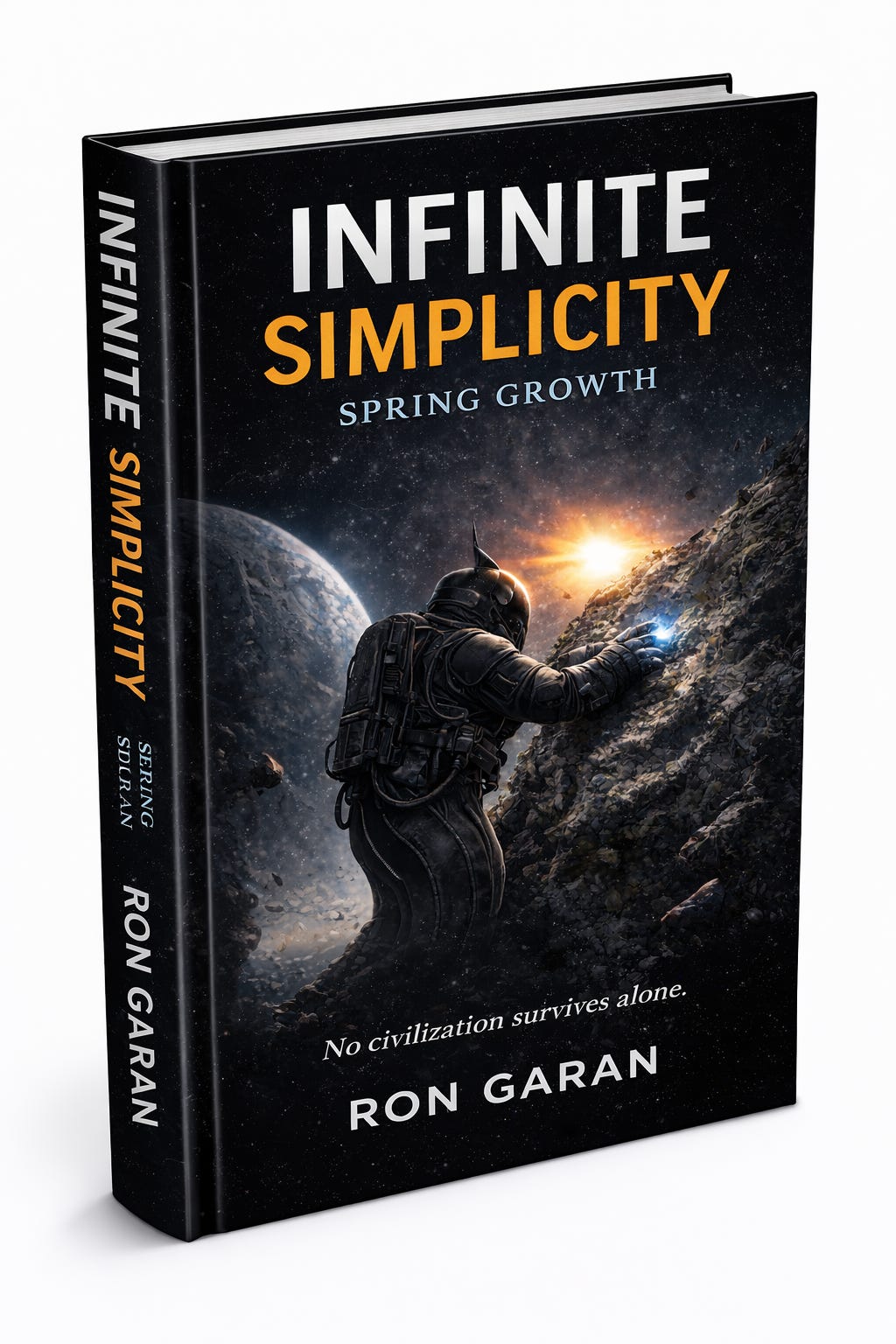
Before we get to Chapter 6, I want to thank everyone who has joined us on this journey.
Since the last chapter, the number of subscribers following Infinite Simplicity has grown to more than 430. A special welcome to everyone who recently joined us through conversations with Marianne Williamson, Rupert Spira, and others.
One of the most rewarding parts of sharing this novel publicly has been discovering that readers aren’t just following the story. They’re engaging with the questions beneath it.
A quick programming note:
Going forward, I’ll be publishing new chapters of Infinite Simplicity every other Tuesday. On the alternate Tuesdays, I’ll share occasional “Between the Chapters” posts, including schematics, reflections, world-building notes, and other material from the universe of the novel.
Chapter 6 explores several ideas that have been quietly emerging beneath the surface of the story from the beginning:
What is the difference between alignment and unity?
What happens when people stop experiencing themselves as separate?
And what, exactly, is love?
After you’ve read the chapter, I’d especially love to hear your thoughts on one question:
Nien describes love as recognition rather than attachment. Does that resonate with you, or does it miss something important?
As always, thank you for being part of the journey.
New here? Start with Chapter 1: Orbital → [link]
Now, on to Chapter 6.
Chapter 6: Convergence
The galley lights come up slowly, timed to our circadian cycle, since no one can agree what morning means anymore.
Nien is already floating near the dispenser, arguing with it.
“If you’re going to call it protein analog,” he tells the machine, “the analogy shouldn’t be this abstract.”
The dispenser hums in what I’ve learned is passive resistance.
“It’s protein slurry with seasoning profiles,” I say as I drift in behind him. “You knew that when you signed the contract.”
“Pretty sure the brochure implied a buffet,” he says.
The dispenser chirps and extrudes two identical meal packets, beige and faintly steaming.
Nien grabs one.
“Two chances to be disappointed. That’s thoughtful.”
We anchor ourselves at the galley rail with our feet hooked through the restraint loops. In microgravity, every bite is a small calculation. Rush it and you wear it.
I peel back the packet seal. The smell arrives a second later, warm, synthetic, almost convincing.
Nien chews thoughtfully.
“You ever think about how strange this is?” he asks.
“The food?”
“No. Us.” He gestures vaguely with his drink bag, which sends him rotating half a degree before he corrects. “Two people eating breakfast while a rock the size of a city is out there, just minding its own business, right on schedule to redraw everything on the planet.”
I glance toward the window. Threshold isn’t visible from the galley, but I can feel its presence anyway, a kind of gravitational pull on my attention.
“It’s not minding its own business,” I say. “It’s obeying physics.”
Which means if we fail, it’s on us.
On my math. The part I can’t blame on anyone else.
I can’t help but think about how different things are from when the asteroid was first discovered and the cataclysmic trajectory was universally confirmed. The threat from the asteroid did what no treaty ever had.
It simplified things.
For a brief moment the world rallied around a single goal: survival.
“Do you think the world remembers how fast we came together to face the asteroid,” I ask, as I savor my protein slurry. “The unity was truly remarkable.”
Nien doesn’t answer right away. He’s looking back at the planet. The burn lines are still clearly visible even at this distance.
“It wasn’t unity,” he says finally. “It was alignment.”
“That’s the same thing.”
“No,” he says. “Alignment is temporary.”
I glance over. “You don’t think the asteroid unified them?”
“It did,” he says. “Long enough to build Jiandan.”
He taps the window frame.
“Jiandan exists because nobody argued about the trajectory solution. Not at first,” he adds. "The threat of extinction made them share models, coordinate production across continents, and move materials through borders that had been closed for years."
“They rallied,” I say.
“They temporarily synchronized,” he corrects. “Different thing.”
“For a while the planet behaved like a single system solving a single problem,” I say.
“For a while,” he agrees.
“What changed?”
He shrugs slightly.
“The trajectory didn’t change,” he says. “People did.”
I look back at the packet stream.
“The trajectory solution is still the same,” I say. “But it isn’t coming through a shared verification network anymore. Everyone’s running their own models now and the answers don’t match anymore.”
“Exactly.”
“Some of them think the trajectory models were shaped to force cooperation they wouldn’t have agreed to otherwise,” he adds. “While others are starting to describe the impact as survivable.”
“No one with the data really thinks that,” he continues. “But some have convinced themselves otherwise and are already competing to control what stays inside the projected survival zones after impact.”
“That doesn’t make sense even if they do think impact is survivable.”
“It makes perfect sense,” he says. “If survival isn’t equal anymore it becomes an opportunity. People start protecting home.”
He looks back at the planet.
“Home gets smaller.”
I sit with that.
“Once survival stopped looking equal, the trajectory updates started arriving with different conclusions attached to the same math,” Nien says quietly. “The packet updates started talking about survival zones, hardened infrastructure, and evacuation corridors. Survival had become something you could position yourself for better than someone else.”
Neither of us speaks for a moment.
“The asteroid’s still heading to the planet,” I say. “Impact means extinction across every validated solution. The math never changed. But regardless, they’re already planning what happens next.”
“They have to,” he says. “The alternative leaves nothing to do but wait.”
“And Jiandan?” I ask.
He looks back at the console.
“Everyone still agrees we should try to deflect it,” he says.
Then after a moment:
“For now.”
We sit with that for a while.
The ship hums around us, steady and mechanical.
Somewhere below us, governments are recalculating acceptable losses.
I can’t help wondering if we’re part of that calculation.
Nien looks back at the planet as he breaks the silence.
“When I was young,” he says, “I thought danger would come with instructions.”
“Like a checklist,” he adds quietly.
“Miss step three, pay the price.”
He exhales and looks away from the window.
“Instead, it just shows up and collapses the distance between you and the consequence.”
A pause.
“Still learning how not to run from that.”
He lets the silence sit there.
I don’t respond.
I tap my artificially flavored drink bag against his.
Once.
He nods.
We eat without speaking for a few moments. Relays click, fans cycle, Jiandan’s hull ticks faintly as it adjusts to temperature shifts. The background hum settles into the spaces between my thoughts. Recorded music barely rises above it.
“I was thinking,” Nien says, “no one down there will ever know what this last meal before the intercept actually tasted like.”
“Which feels unfair to the meal,” he adds. “If it works, it’s anonymous. If it doesn’t, it’s irrelevant.”
He shrugs. “Strange trade.”
“Not everything that matters leaves a trace,” I say.
He raises an eyebrow. “You always get philosophical when the flavor packet hits.”
“I can’t help it,” I say. “Things just look different from this perspective.”
He lets go of his meal packet and watches it float between his hands.
“You think people need to leave the planet to see clearly?”
“No,” I say. “I think leaving just removes some of the excuses.”
He smiles at that, then frowns slightly.
“You think they’ll change after this?”
“Some will,” I say. “Some won’t. Most will argue about what it meant.”
Nien studies me for a moment.
“And us?”
“We’ll still be here,” I say. “Cleaning crumbs that don’t fall.”
At that exact moment, a tiny glob of sauce escapes his packet and floats between us, wobbling gently.
We both watch it.
“Don’t move,” he says.
“I’m not moving.”
The glob drifts toward the intake vent.
“Okay, now,” he says.
We lunge at the same time, collide softly, and spin apart laughing as the glob vanishes into the filter with a quiet slurp.
Nien wipes his hands on a cloth.
“See,” he says. “Heroism.”
“Truly legendary.”
He finishes the last bite and seals the empty packet.
“Hey,” he says after a moment. “If this goes bad…”
I look at him.
“If it goes bad,” he continues, “I just want you to know that I don’t regret being here.”
He doesn’t meet my eyes.
“Me neither,” I say.
I don’t know if that’s true.
He pushes off toward the hatch.
“Next meal,” he says, “I’m choosing the playlist.”
“That’s not how co-command works,” I counter.
He grins over his shoulder.
“Exactly.”
∞
It’s a few hours after our protein slurry breakfast. Nien picks up the camera.
“OK, Aadi,” he says. “Ready to get this over with?”
“Let’s do this,” I reply, louder than necessary.
He points the camera at me and motions silently with his hand.
“Hello from space. I’m Flight Engineer Aadi Kael.”
Nien flips the camera toward himself.
“And I’m Pilot Nien Ren. We’re coming to you from the deflection vehicle Jiandan, representing the thousands of people working tirelessly on the ground to keep this mission moving forward.”
He turns the camera back to me.
“We want to thank everyone who has supported this mission,” I say. “Please know that we carry your hopes and prayers with us.”
I push gently toward the center of the flight deck.
“We’re on Jiandan’s flight deck. This is where we control the vehicle’s trajectory and most of the onboard systems.”
I drift toward the port side and hook my feet under restraint straps.
“Nien’s pilot station is right here. Just below this photo of his wife Lian and their beautiful children sit the hand controllers he uses to fly the vehicle. He’s had that photo with him since training. He says it helps him remember what direction “up” is supposed to be. Sometimes he even lets me fly.”
Nien flips the camera back toward himself.
“Only when Aadi finishes all his other tasks,” he says.
I reach over and nudge the camera back toward me.
“And this is my flight engineer station. From here I manage the systems that keep us and the ship healthy and functional.”
I gesture toward the windows behind me.
“As you can see, we also have three large viewports, (pressurized observation bays we can fit inside) and numerous windows.”
Nien drifts up to his waist into the starboard viewport and frames the shot.
“Each one faces a different direction,” I continue. “Port, starboard, and forward. Together they give us almost a full view around the vehicle.”
The camera tilts slightly downward along the length of the vehicle.
“From here you can see the entire assembled spacecraft. It really gives you a sense of the scale of this machine.”
“Just beyond Jiandan,” I say, “you can see a thin blue crescent.”
Nien shifts the camera slightly.
“That’s the planet.”
I pause, longer than I meant to.
“Everyone we’ve ever known is down there. Everything that’s ever mattered to us.”
The words catch me off guard.
Another pause.
“From here, it looks… whole.”
I don’t say unified.
The distinction feels important, though I can’t quite explain why.
“Distance makes it look simpler than it is.”
I hesitate.
“And whether we experience it as a whole or not,” I add, remembering to get back to the script, “we’re all moving through this together.”
I clear my throat.
“If you follow the vehicle aft—”
At the far end of the vehicle the engines are barely visible.
“Those three shapes at the end are our main engines. They look small from here, but each one is large enough to fit Nien and me, and about eight friends.”
I pause.
“That is, if we had eight friends up here.”
“Which we don’t,” Nien says with a laugh from behind the camera. “Payload constraints.”
I push gently toward the aft hatch. He follows, rolling smoothly behind me. The camera rolls with him, making it look like I’m the one rotating.
“Just through this hatch is our galley,” I say. “This is where we prepare and of course, enjoy our meals.”
“Speak for yourself,” Nien says from behind the camera.
I continue drifting inside.
“We also spend most of whatever free time we have here. That’s why this module ended up covered in photos from home and the cards and drawings many of you sent to come with us on the mission. Some of them arrived before launch. Some arrived after we left.”
“Some of them are already starting to curl at the corners. Nien has been taping them back down as fast as he can.”
I pause.
“So in a way, you’re all here on this mission with us.”
I glance at one of the drawings taped near the viewport.
“That means more than you probably realize.”
The words are out before I decide to say them.
I move toward the next hatch.
This module also doubles as our medical bay. Hopefully the least active part of the ship.
“If you follow me, I’ll show you the airlock.”
I pass through the hatch, turn to the right to enter the airlock, then rotate to face the camera between the two suits mounted along the wall. Nien frames the shot carefully.
“These are our EVA suits,” I say. “EVA stands for Extra-Vehicular Activity. It’s what we call a spacewalk out here. If we need to perform maintenance outside the vehicle or respond to an emergency, this is where we leave the ship.”
I rest one hand lightly against the airlock wall.
“In a few days, this is where Nien will leave to begin the deflection operations.”
Nien drifts past me and films the external hatch.
“And this,” he adds, “is the hatch we use to head out into space.”
I push off the wall with my feet, exit the airlock, and continue drifting aft.
“There’s one more stop.”
I enter my crew quarters and turn to face the camera.
“This is my crew quarters. It looks small, but without gravity it’s more than enough space.”
I tug on my sleeping bag that’s secured along the wall.
“This is where I sleep. As you can see, I keep my sleeping bag attached.”
I gesture toward Nien’s crew quarters across from mine.
“For some reason Nien leaves his untethered and just lets himself drift.”
“Trust the flow,” he says from behind the camera.
“He means ventilation,” I add with a smile.
“Over here is my workstation. The first thing I do each morning is turn on this display. It shows the day’s timeline. Do you see this red vertical line that’s sliding slowly across the screen? My job, as it is every day, is to stay ahead of the red line. So far today we’re doing pretty well.”
I glance around my quarters.
“My crew quarters also hold most of my personal effects. Photos of family, friends, and a few favorite places back home.”
I gesture toward the small window beside the sleeping bag.
“And this window lets me watch the stars while I drift off to sleep.”
I point toward the opposite wall.
“Across from mine is Nien’s crew quarters, but we’re not going to show that because he informed me maid service hasn’t arrived yet.”
The camera moves side to side in a silent protest.
I stop at the hatch leading deeper into the stack.
I take the camera from him and angle it down the remainder of the vehicle stack.
“If we continued farther aft, we’d pass through the Storage Module, then the Life-Support Module, which contains the systems that keep us alive, and finally the Propulsion/Energy Module. That’s where the engines, fuel systems, and the nuclear reactor that keeps the lights on are located.”
“The aft modules are mostly equipment and crawlspace,” I add. “Not exactly cinematic.”
I turn the camera back toward Nien.
“Thank you for coming aboard Jiandan with us today,” he says. “We hope you enjoyed the tour. And we can’t thank you enough for the trust you’ve placed in this mission.”
He pauses slightly.
“We feel you with us up here.”
“We’ll do everything we can to make this mission a success,” he continues. “From Aadi and me, thank you.”
“We’ll see you on the ground in a few weeks.”
“And… cut,” I say, lowering the camera.
“Not bad,” Nien says. “I think that will do.”
“I hope PAM is happy,” I reply.
Nien grins.
“That’s all that really matters.”
∞
Our scheduled tasks for the day are over. We eat while a playlist we dubbed “Soft & Calm” runs quietly in the background. Nien is staring at the photos taped along the galley wall.
“That one’s old,” he says.
“The one with Lian?”
He nods.
“That was before the kids.”
I look at it again.
“You must miss them,” I say.
“Of course.”
He studies the image for a moment longer.
“But it’s not the way I expected,” he adds.
“What do you mean?”
He takes a sip from his drink bag before answering.
“I used to think loving someone meant caring what happened to them,” he says. “Protecting them. Staying connected no matter how far away you were.”
“That sounds about right.”
“It is,” he says. “It’s just not complete.”
I wait.
“When our first child was born,” he continues, “something changed. It stopped feeling like I was caring about someone else.”
He gestures toward another photo, this one with his whole family.
“It felt like recognizing someone.”
“Recognizing who?”
“Myself,” he says. “But not the version of me I usually think of.”
I don’t answer right away.
“That sounds confusing,” I say finally.
“It was,” he agrees. “At first.”
He shifts slightly in the restraint loop.
“With Lian, it felt like discovering someone I belonged with. She just… stayed steady when things didn’t,” he says. “With the kids, it felt like discovering there wasn’t as much distance between us as I thought there was.”
“Distance how?”
“Any kind,” he says. “The kind you assume is there just because there are two of you.”
I think about that.
“So love is… what?” I ask.
He smiles a little.
“Recognition,” he says. “You stop relating to someone like they’re separate from you.”
“So what, you’re saying love is just… relationship collapsing?”
The phrase feels clumsy, but I can’t think of a better one.
Nien raises an eyebrow.
“Relationship collapsing?”
“You know what I mean.”
“Wow,” Nien says with a laugh. “And you haven’t had a flavor packet in hours.”
Then, quieter:
“It doesn’t feel like collapse,” he says. “Not at first.”
He glances back at the photo.
“More like… you stop pretending there was distance.”
The words feel familiar.
I find myself wishing they didn’t.
“With Lian and the kids, it stopped feeling like I was holding on to something I could lose,” he says. “It started feeling like I was already inside something that didn’t begin or end with me.”
I don’t know what to do with that.
Part of me wants to dismiss it as sentiment.
“I always hoped I’d find something like that,” I say after a while.
“You still might,” he says.
“I don’t know,” I admit.
He studies me for a second.
“It doesn’t always arrive as romance,” he says.
He taps the edge of the family photo lightly.
“Sometimes it shows up looking more like recognition.”
Something in me tightens.
Questions form.
I don’t ask them.
Thank you for reading.
Infinite Simplicity is a novel in progress, and I’m grateful to everyone who is helping shape it through their reactions, comments, and questions.
Chapter 6 contains a line that has stayed with me:
“Sometimes it shows up looking more like recognition.”
I’d love to hear your thoughts.
Do you think love is best understood as connection, attachment, commitment, sacrifice, recognition, or something else entirely?
Even a brief comment helps me understand how readers are experiencing the story and which ideas are resonating most strongly.
Thank you for being part of this journey.
Ron
If you’d like to follow the story as it unfolds, subscribe below.
The differentiation between alignment and unity in this chapter nails a very important piece about peace in the world. As long as there is separation, there can only be that temporary state of alignment and temporary peace.
When people stop experiencing themselves as separate, there is only unity, only one. It's an interesting part to me that unity doesn't mean sameness. The source is one, the same, but there is the incredible differentiation and uniqueness of each form that is made of the same stuff. A miracle.
And what is love you ask? Receiving everything as myself, acceptance, love is that stuff we are all made of, come from. Hard to define with words but we all know what it is, even if we don't live that most of our lives. Love as recognition rings true. That's a new description for me and it fits the receiving everything as self. In attachment, it's mostly a trading game. You do this or give me this and I will reciprocate. I need you to fulfill my "needs".
I like this chapter the best so far. Rich metaphors and interpersonal dynamics. thank you
Heady-stuff here. In order to maintain a cohesive simplified reasoning thought process I would say that "love" is not generated or perceived as a singular foundational framework stemming from any single act. We can all have a connection, an attachment, a personal sacrifice or a sensed recognition of someone or something that is reflectively familiar but it wouldn't be true to say it is love. I think to have love, know love, be loving and be understanding of it as a distinguishing facility and faculty within ourselves we need to be perceiving it from the deepest and most integrated element of our conscious experience. The outer acts of engagement with others are a kind of psycho-spiritual and psycho-social scaffolding that constructs an ability to hold that "communion" thru a perception that is either reflective of the beholder's deepest need for emergence, identity and affirmation of their deepest authenticity and value or more simply an egoic device that our conditioned selves require to deflect from our own highest self, the sense of isolation, being alone and being "unlovable". Nien tells Aadi, regarding his feelings for his wife and children "it stopped feeling like something I could lose" and shifted into "it started feeling like I was already inside something that didn't begin and end with me." Nien, holds a communion with his deepest most inner authentic self-identity and with an external communal relationship to which he ascribes the same attributions of authenticity ,depth and spiritual emergence as himself. The "I' becomes a "we" and their is no separation of the inner experiences, there becomes no beginning or ending to the self alone. Love provides an energetic vibrational frequency held together by humanity and it's co-relational representation with their creator. Thank you ,Ron, the storylines are very compelling and really timely as humanity as a consciousness is shifting into the new cosmic relationship to human consciousness.