
Infinite Simplicity | Chapter 4: Resonance

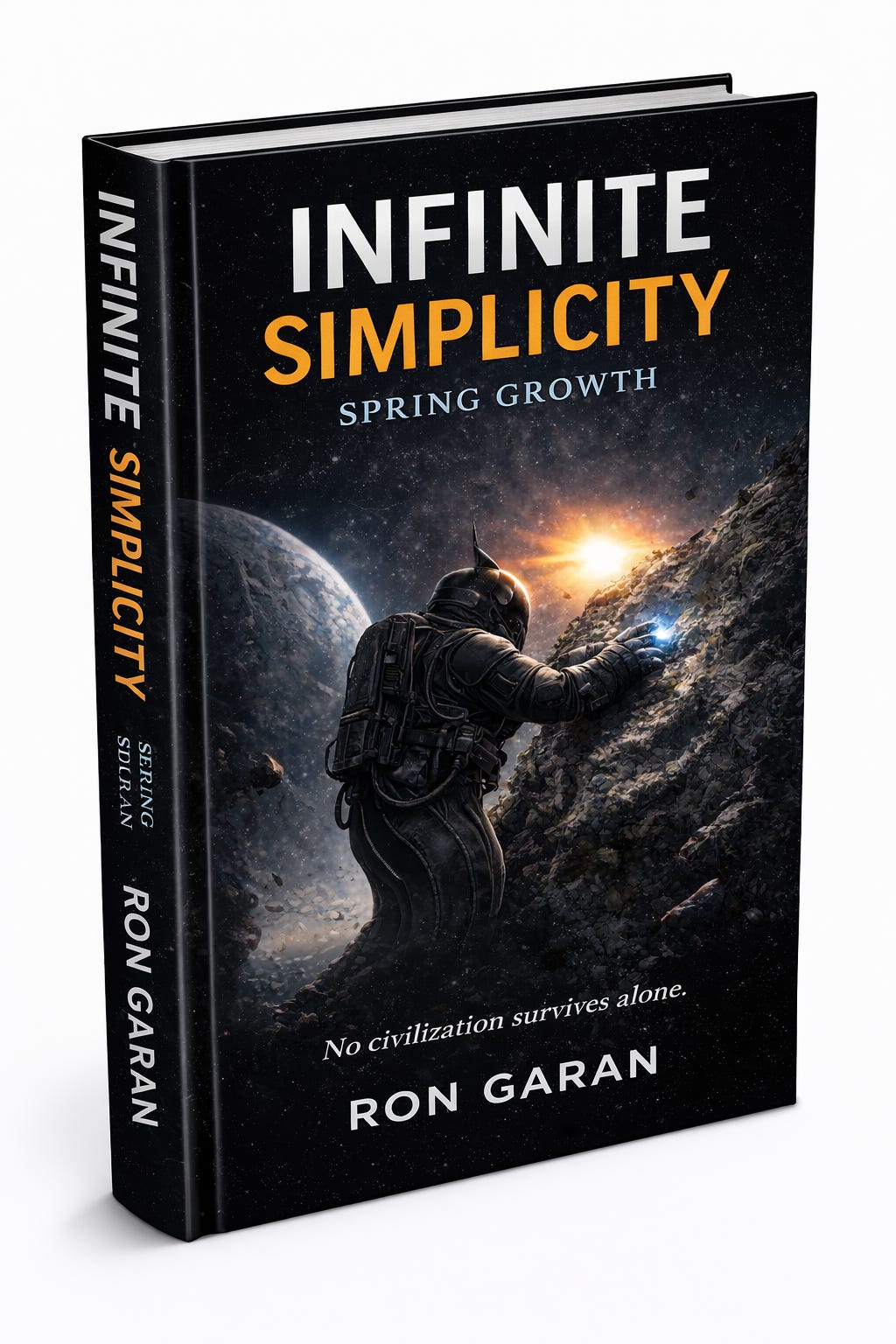
For the past several years I’ve been working on a science-fiction novel called Infinite Simplicity.
It explores a question that has fascinated me for a long time: what determines whether civilizations survive their inflection points — or collapse under them?
I’ve decided to share the story here as it unfolds.
Below is Chapter-4.
Thanks for being here! Subscribe for free to receive new posts and join the journey.
New here? Start with Chapter 1 → [link]
Chapter 4: Resonance
Coherence is the answer.
The thought arrives fully formed, like a data-burst. It isn’t mine. At least I don’t think it is.
My attention shifts from what I’m doing. The ship hums around me. Fans cycle, pumps whisper, everything continues exactly as it should.
I swallow.
That wasn’t a voice.
It appeared complete, as though it had always been there and I had only just noticed it.
“What?” I murmur, careful not to let Nien hear.
A moment passes. Then:
Coherence.
I feel a tightening in my chest. A sudden, irrational urge to look over my shoulder, even though I know no one is there.
“What is coherence?” I ask silently this time. Maybe not silently. I honestly can’t tell.
Stop searching.
You are not outside it.
A pause.
The search is what keeps it hidden.
The words feel familiar in a way I can’t explain.
A phrase surfaces from somewhere I don’t remember.
The pathless path.
I almost dismiss it. It sounds like something people say when they don’t have an answer.
“It’s not a voice,” I whisper out loud, the sentence forming with an edge of panic now. “It’s a thought. It’s my thought.”
A flicker crosses my vision, thin, needle-bright streaks of light, gone almost as soon as they appear. I blink hard. The stars outside the window remain steady.
“Why do you sound like me?”
The response comes without hesitation.
Of course I sound like you.
Who else could I sound like?
This is new.
Before, there were impressions, fragments, phrases that felt remembered rather than heard.
This… this is a conversation.
I don’t know what to do with that.
My heart pounds, fast enough that my training kicks in automatically. I force my breathing to slow, counting the rhythm the way I was taught. In. Slow. Out. Slow. Again.
“This isn’t possible,” I think. “It’s the stress, the mission, the suit malfunction. I lost consciousness only days ago. The brain fills gaps. Hallucinations happen.”
Yes.
And so do recognitions.
Another flicker. Brighter this time. A faint afterimage lingers at the edge of my sight, like a camera flash seen through fog.
Gamma-ray bursts. Background radiation from dying stars. Constant. Usually invisible.
The explanation arrives like a pre-flight checklist. Maybe remembering that will help me deal with this. Whatever this is.
My hands grip the edge of the console.
“Nien,” I say aloud, just to anchor myself. “How’s the trajectory?”
“Nominal,” he replies without turning. “Why?”
“Just checking,” I say quickly.
A pause.
“You okay?” he asks.
“I’m fine,” I say.
The response is automatic.
If I’m not fine, I’m sidelined.
If I’m sidelined, I don’t get a vote, and the mission runs without me in it.
I turn my attention back to the task list, forcing my mind into familiar grooves. Bracket tolerances, thermal expansion coefficients, detonation sequencing.
Numbers behave.
The presence doesn’t intrude.
That feels worse.
Minutes pass. Or seconds. Time feels unreliable, the way it does when something fundamental has shifted and the mind hasn’t caught up.
Finally, cautiously, I think: “If this is coherence… then what am I supposed to do?”
You are already doing it.
A chill moves through me.
“That’s not an answer,” I think.
It isn’t meant to be an answer. Only an observation.
Hu’s last message surfaces uninvited: We need a commit window.
I close my eyes.
“An observation of what?” I ask.
That you decide what counts.
“What does that mean?”
What you surface becomes real.
What you don’t remains hypothetical.
The words feel uncomfortably precise.
That’s ridiculous.
I follow procedures. I surface what meets review criteria. I manage noise. I keep the picture usable.
I don’t decide.
The thought doesn’t hold.
Every day, I defer edge cases and quiet outliers.
And then I think of the deep-coupling run. The amber coastal band pushed far enough into the background that no one has to deal with it.
I keep circling this one branch.
If I raise it now, Nien will slow the approach. He’ll ask for more analysis. Hu will call it hesitation. I can already hear him asking for justification and quietly taking me out of the loop.
The window will thin while we argue.
If I leave it buried, the plan holds. The amber stays abstract. No names. No faces. The clock keeps running.
And so do I.
I can’t tell whether the message was about this branch or the habit that made burying it feel responsible or something else entirely.
I reopen the deep-coupling pane.
The share control sits in the corner of the display, one command away.
I hold there.
Then I collapse the pane and leave the primary solution active.
A line updates in the margin.
Accepted.
MET 29:14:05:33.
No undo.
My jaw tightens.
I duck behind a storage rack.
What is happening?
For a moment, I consider telling Nien. The words form in my head: I’m hearing something. Not hearing. Thinking. Something else is thinking with me. The image of his expression rises in my mind: concern, then the question of whether I’m still someone he can trust up here.
I let the thought dissolve before it becomes something I have to explain.
Not yet.
I force my attention back to the displays. Whatever this is recedes into the background. Like a signal dropping below the noise floor. I still feel its presence, but it’s unreadable. A residue remains. A sense that something has been tuned, slightly but irreversibly. As if a dial has been turned just far enough that static has become pattern.
Am I losing my mind?
The odds aren’t zero.
One psych flag and I don’t get to touch the full stack again and someone who’s not here finishes this with Nien.
Without me.
I resume my work, slower now, more deliberate. Outside, the stars hold their positions. Threshold remains a faint irregularity ahead, still unreadable, still indifferent.
Inside, something has begun to resonate.
And I have the unsettling sense that it has been waiting a very long time for me to notice.
Infinite Simplicity is a novel in progress.
I’m sharing it here as it unfolds.
If you have reactions, questions, or places where the story pulled you in — or lost you — I’d genuinely value your feedback in the comments below.
If you’d like to follow the story as it unfolds, subscribe below.